
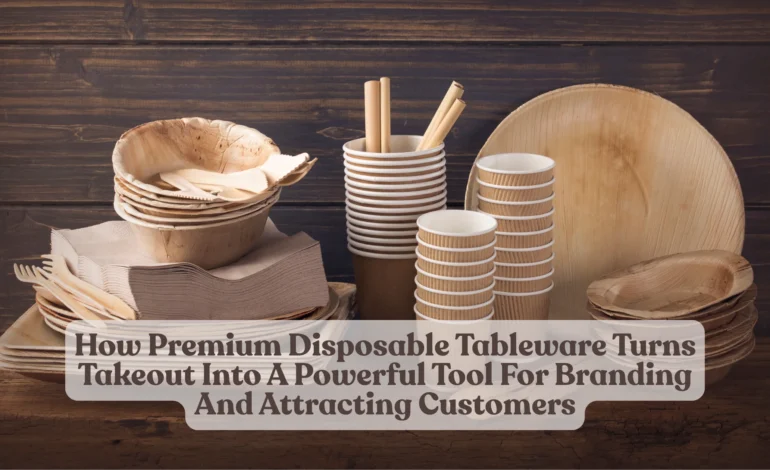
How premium disposable tableware turns takeout into a powerful tool for branding and attracting customers

The quality of disposable drinkware and packaging materials has a greater impact on the perception of a restaurant brand than owners realize. Packaging design influences the purchasing decisions of 72% of American consumers, while packaging materials influence 67% of buyers. Every order delivered serves as a free tool for shaping the brand’s image.
Table of Contents
Why packaging shapes opinions about a brand faster than food
“Silent initiator” is what marketers call packaging. Visual appeal triggers interaction before the customer even tries the first bite. Colors, fonts, and graphics create a narrative in seconds.
The context of food delivery reinforces this principle. When receiving an order in high-quality packaging, the customer reads the signals: attention to detail, customer care, and the premium nature of the establishment. Human perception prioritizes color over form by 80%. Red stimulates appetite, green is associated with health, and black with premium quality.
The economics of proper packaging: the unvarnished facts
How material changes perceived value
Consumers perceive products in cardboard packaging as more expensive than those in plastic packaging, with a difference in perception of up to 30%. Disposable food containers made from high-quality materials allow meals to be positioned in the premium segment at the same price.
Mobile advertising in every order
Effective packaging design generates long-term brand capitalization. Each order becomes a carrier of corporate identity, forming positive associations. The cost of premium packaging pays for itself through increased loyalty and repeat orders.
Trends for 2025: sustainability as the new premium
Ecology = profitability
51% of respondents consider the environmental factor to be key when choosing packaging in 2025. 25% of high-income millennials are willing to pay significantly more for environmentally responsible solutions. Differentiation through an eco-friendly approach is particularly effective in large cities, where consumers are willing to pay more for shared values.
Technology at the service of engagement
QR codes transform static packaging into an interactive channel. Consumers gain access to the composition of a dish, the history of an establishment, and loyalty programs. Advanced restaurants post links to playlists and recipes — the container becomes part of the entertainment content.
Segmentation by concept: a unique approach for each establishment
Premium: when every detail matters
29-42% of consumers in the US associate glass jars with reliability. The principle applies to any premium materials: the quality of the packaging conveys the quality of the contents. Details are everything: embossed logos, unusual textures, thoughtful ergonomics.
Fast food: speed plus recognition
Consumers are looking for iconic images that raise their status. “I would look cooler with this packaging” — this is exactly the feeling that fast food packaging should create. Bright colors, large logos, practical shapes.
Original concepts: packaging as a manifesto
Themed restaurants use packaging to extend their philosophy. The trends of 2025 encourage creativity and authenticity. Instead of sterile minimalism, there are lively doodles, hand-drawn elements, and imperfect lines.
This approach reflects a counter-reaction to digitalization: consumers crave humanity in design. “Made by people for people” is a message that resonates with the audience.
Practical selection of materials: efficiency criteria
What really works
Modern disposable plastic containers offer much more than meets the eye. Containers must preserve the temperature and texture of food. The insulating properties of modern materials allow food quality to be maintained even during long deliveries.
Color psychology in action. Green packaging receives higher health utility ratings than the original colors. Warm shades are suitable for “sinful” dishes (burgers, desserts), while cool shades are suitable for healthy foods (salads, smoothies).
Environmental friendliness as a competitive advantage. Biodegradable materials, recycled cardboard, plant-based polymers — investments in such packaging pay off in the form of loyalty from eco-conscious customers.
Packaging budget management
The market for high-quality restaurant supplies will reach $32.42 billion by 2030. Three factors are driving the 4% annual growth rate: demand for sustainability, growth in e-commerce, and requirements for visual appeal.
Investing in high-quality packaging is a long-term strategy. Short-term costs are offset by increased loyalty and more frequent orders. Saving on packaging today means losing customers tomorrow.
Design trends: what’s working right now
Minimalism versus information noise
Consumers are tired of overloaded packaging with dozens of certificates. Simplicity has become the new luxury. The rule of three: a maximum of three key messages on the front of the packaging.
Authenticity vs. perfection
2025 is marked by a trend toward “imperfect” design. Scribbles, hand-drawn elements, uneven lines — all of this creates a sense of humanity. Consumers are oversaturated with perfect digital images and are drawn to the living, imperfect, real.
This trend is especially effective for small local restaurants that want to emphasize their intimacy and original approach.
Measuring effectiveness: KPIs for packaging strategy
Metrics that matter
Repeat orders are the main indicator of a successful packaging strategy. Customers return not only for the taste, but also for the pleasant experience of the entire process of receiving food.
Social mentions of packaging in reviews and posts indicate that the design has caught the audience’s attention. User-generated content with photos of packaging works as free advertising.
Brand recognition increases in proportion to the quality of packaging solutions. 94% of consumers show greater loyalty to brands with complete transparency — packaging must clearly communicate the values of the establishment.
Long-term planning in numbers
The share of food delivery in global food spending has grown from 9% in 2019 to 21% in 2024. The trend will only intensify: consumers are becoming less tolerant of inconveniences and more demanding of service.
Takeout packaging is becoming the main channel of communication with customers. Restaurants that ignore this fact risk losing their competitive advantage.
The technological future of packaging
Integrating sensors into packaging allows you to monitor freshness, track temperature, and determine the optimal time for consumption. Augmented reality transforms packaging into an interactive platform. Pointing a camera at it can launch a video with a chef or a virtual tour of a restaurant kitchen. Digital printing allows you to create unique packaging for each order with personalized messages.
Conclusion
Investing in premium packaging is not an operating expense, but a strategic investment in brand capitalization. Consumers will continue to raise the bar for expectations: speed, reliability, environmental friendliness, aesthetics — everything must be of the highest standard.
High-quality packaging solves several problems at once: it meets growing customer expectations, conveys brand values, and acts as mobile advertising. Restaurants that invest in packaging solutions today are laying the foundation for a competitive advantage tomorrow.
The era when only the taste of food mattered is over. The customer experience is made up of many details, and packaging is one of the most noticeable. Ignoring its influence means voluntarily giving the market to more forward-thinking competitors.